
Customer Case Study · Retail
One national retail network,
secured and simplified
How Small Robot rebuilt a national specialty retailer's network, cut its running costs and shut down its exposure to ransomware and phishing — using Cisco.
Client name and logo withheld at the customer's request
(name withheld)
About the client
A well-established national specialty retailer, built on hands-on expertise and in-store service.
The client is a long-standing Australian specialty retailer with stores spanning Victoria, New South Wales, the ACT, Queensland, South Australia and Western Australia, backed by a national online business, a distribution operation and a head office team.
This is not a commodity retailer. Its business runs on expert advice, hands-on demonstration and in-store education, which puts real weight on the technology behind the counter. Point-of-sale, stock lookup, customer records, printing services and digital signage all have to work — in every store, every trading hour.
Like most Australian retailers of its size, the business carries a lean internal IT function. The technology has to look after itself, and when it doesn't, it has to be someone's job to fix it fast.
The challenge
A network that cost too much, did too little, and left the business exposed.
The client's technology estate had grown store by store over many years. Each addition made sense on its own. Together, they had become expensive to run, slow to change and difficult to defend.
Expensive, unreliable connectivity
Stores ran on costly carrier links locked to a single vendor. Performance was inconsistent, outages interrupted trading, and the contracts offered little room to move on price or design.
High management overhead
Keeping the network running consumed disproportionate time and money. Diagnosing a problem in one store often meant sending someone to that store.
Slow, painful change
Opening a store or relocating one turned into a project. Lead times on carrier services and hands-on configuration work held up decisions the business had already made.
Real cyber exposure
Ransomware and phishing are the two threats that hurt Australian retailers most. Shared store computers, flat networks and inconsistent controls gave an attacker far too much room to work with.
The underlying issue
None of these problems were separate. Expensive connectivity existed because the network could not safely use cheap internet. Change was slow because every site was a snowflake. Security was hard because there was no consistent identity, no consistent endpoint control and no one watching after hours. Fixing any one of them in isolation would not have held.
What Small Robot did
Assess the whole estate first. Then rebuild it in the right order.
Small Robot began with a full assessment across four domains — network, user workspace, cybersecurity, and Microsoft 365 licensing. That assessment mattered. It showed which costs were real, which controls already existed but were switched off, and which changes had to happen before others could.
- Right-sized Microsoft 365. We rationalised licensing so the retailer paid for the features it actually used — and switched on security capability already included in the licences it held.
- Hardened what was already there. We reconfigured existing systems to a secure baseline before adding anything new. Configuration is free. Products are not.
- Cisco Umbrella for internet threat protection. Malicious domains, command-and-control callbacks and phishing destinations are blocked at the DNS layer, in every store and for every user, before a connection is ever made.
- Cisco Duo for head office. Strong multi-factor authentication, single sign-on and risk-based access. Staff sign in once; Duo decides when a login needs a closer look.
- Cisco Duo for retail stores. Shared store computers are the hardest identity problem in retail. Duo gave store teams a fast, simple way to prove who they are on a shared device — security that fits the way a shop floor actually works.
- Cisco Secure Endpoint across host computers. Continuous protection and visibility on every machine, including the ability to trace exactly what happened if something gets through.
- 24×7 threat detection and response. We enabled logging into Small Robot's partner organisation, Neko Security, which monitors the environment around the clock and responds to threats outside trading hours as well as during them.
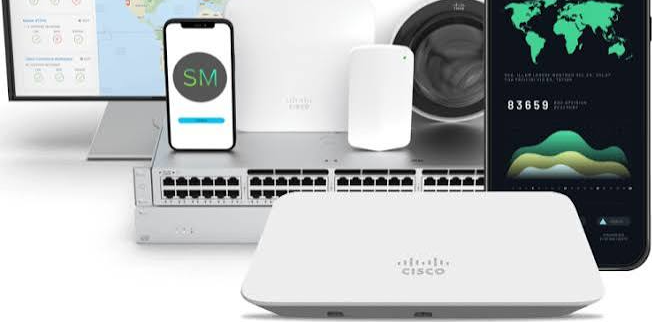
- Cisco Meraki network, managed by Small Robot. We upgraded and transformed the network onto Meraki, centrally managed by Small Robot. Every site is now built from the same template and configured from one dashboard.
- Commodity internet instead of vendor lock-in. With traffic secured and monitored over Meraki, the retailer moved off expensive, locked-in carrier services to standard business internet — without giving up control or visibility.
Why this order
The licensing and hardening work funded and de-risked everything that followed. The Meraki transformation is what made cheap internet safe to use. Duo, Umbrella and Secure Endpoint gave Neko Security something worth monitoring. Each step made the next one possible.
One network, nationally
Every store connected over Cisco Meraki. Managed by Small Robot. Monitored around the clock.
The results
Cheaper, faster, and materially harder to attack.
| Area | Before | After |
|---|---|---|
| Cyber security | Exposed to ransomware and phishing, with inconsistent controls and no after-hours coverage | No material security incident since the new controls went live, with 24×7 monitoring by Neko Security |
| Network reliability | Inconsistent performance and outages that interrupted trading | Reliable connectivity with significantly improved performance across every site |
| New stores & moves | Long carrier lead times and hands-on configuration at every site | Standard templates and commodity internet let the retailer open and relocate stores quickly |
| Connectivity cost | Premium vendor-locked carrier services | Commodity internet, secured and monitored over Cisco Meraki |
| Software licensing | Paying for Microsoft 365 features the business did not use | Right-sized licences, with included security features switched on |
| Management overhead | Disproportionate internal time spent keeping the network alive | Centrally managed by Small Robot from a single Meraki dashboard |
What it adds up to
The retailer has taken cost out in four places at once: software licensing, management and operational overhead, internet and communications, and the cost it has not had to carry — a cyber incident. For a retailer, that last one is the largest number on the page and the easiest to overlook.
In their words
“Small Robot have made our business secure. No more ransomware or compromised credentials. Additonally, our business is better connected and more cost effective to operate through their managed network and security services. I only wish we made the change earlier.”
Where things stand today
The retailer remains a Small Robot and Cisco customer. The network, security controls and workspace are managed day to day by Small Robot, monitored around the clock by Neko Security, and continue to evolve as the business opens, moves and refits stores.
The measure of the work is not the technology list. It is that the retailer stopped having to think about any of it.

Running a business on a network you can't rely on?
Small Robot designs, deploys and manages secure networks for Australian businesses using Cisco technology — with 24×7 threat detection and response behind it.
Talk to Small Robot